Domain accuracy
- Showing the steps is worth more than showing the answer, because a reader can check the work.
- Marking data as unverified is honest and cheap; hiding the gap would have been neither.

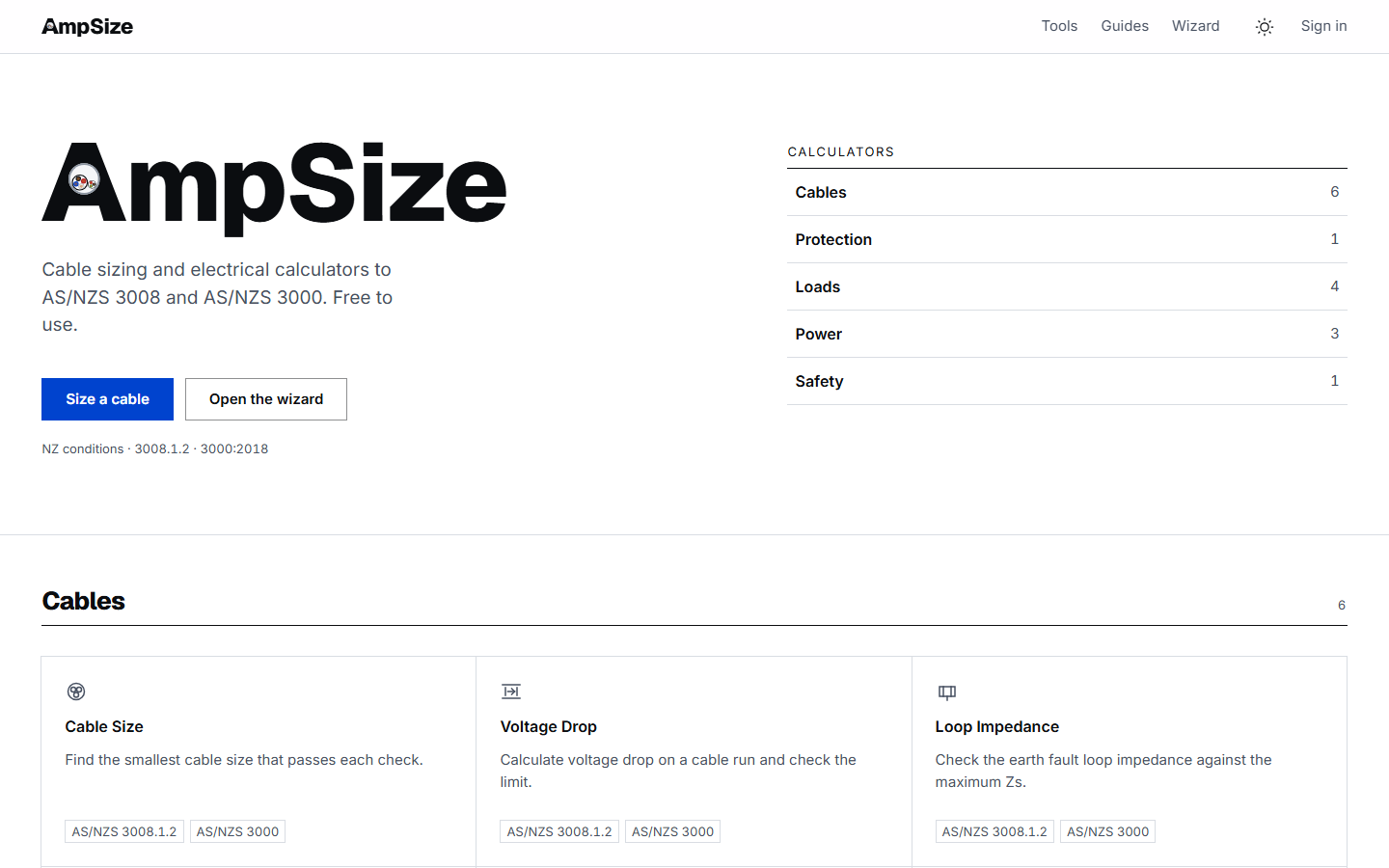
Cable sizing and electrical calculators to AS/NZS 3008 and AS/NZS 3000 for New Zealand and Australia.
AmpSize runs 15 calculators that show worked steps and name the clause or table behind each result. Guides work one case from end to end, and learn pages explain one idea each. Signed-in users save calculations, group them into projects and export PDF reports. An Android build ships on the Play internal track, and every standards table carries a verification status. Built between 17 and 19 September 2026.
The engine sizes cables and checks voltage drop, loop impedance, fault rating, conduit fill, max demand, motors and more. Every calculator prints the intermediate values, not just the answer, so a reviewer can follow the arithmetic.
Each step cites the standard, edition, table and clause it reads. The cable size result names AS/NZS 3008.1.2:2017 tables for derating and AS/NZS 3000:2018 clauses for the checks.
Guides solve one real case with numbers, such as a 32 A single-phase 25 m run. Learn pages cover one idea each, in plain words, and link to the calculators that apply it.
A calculation encodes into a shareable state, so a saved item and a PDF link carry the same inputs. Users group saved work into projects and export a report for a job file.
An Expo Router app reads the same calculation engine and design tokens as the web app. The internal test build is live, so the phone and the browser return identical numbers.
Every table is JSON with a header naming the standard, edition and status. A derived table shows an under review badge until someone checks it against the licensed copy.
An electrician acts on these results, so a wrong table is a safety problem. The fix was a status flag on every table, and a badge on any calculator that reads a derived one. An admin toggle flips the flag without a deploy.
The web app and the mobile app must never disagree. The calculation engine is a pure package with no input or output, and both clients compile it from source. There is one implementation and one set of tests.
A saved calculation, a shared URL and a PDF all need the same inputs. A single encoded state package handles all three. That removed drift between what a user saw and what the report printed.